
Second-guessing your spelling in the middle of writing a critical document happens to everyone. You type a word that feels completely normal, but the red squiggly line of a spellchecker suddenly shatters your confidence. The volumn vs volume debate plagues countless professionals and students every single day.
This guide breaks down exactly why this mix-up occurs and provides foolproof memory tricks to guarantee accurate communication. Mastering these rules ensures your formal writing remains sharp, clear, and perfectly spelled.
The Immediate Answer: Volumn Vs Volume And The Single Correct Choice
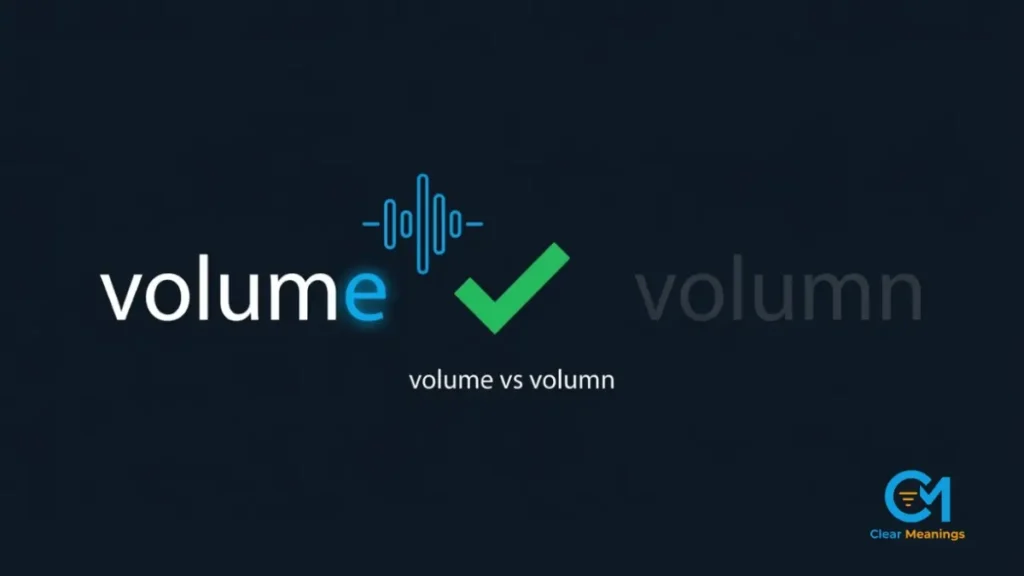
Volume is the only correct and recognized spelling in the English language, referring to both physical space and sound intensity. The spelling volumn is a common typographical error and is completely invalid in all dialects.
| Feature | Volume | Volumn |
| Status | 100% Correct | Completely Incorrect |
| Spelling Rule | Always ends with an ‘e’ | Never ends with an ‘n’ |
| Dictionary Recognition | Universal acceptance | Not recognized |
Psychological Memory Tricks To Never Type Volumn Again
Our brains often betray us when translating spoken words into typed letters on a screen. Using specific mnemonic devices will permanently wire the correct spelling into your muscle memory. Try applying the following mental shortcuts before hitting send on your next message.
The Column Rule For Remembering Volume
The visual similarity to the word “column” creates a dangerous spelling trap for many writers. Because “column” legitimately ends with an “mn”, our typing habits automatically try to apply the same rule to “volume”. You must actively separate these two terms in your mind by remembering that columns hold up buildings, while volumes measure space.
The Silent E Association For Sound And Space
Connecting the spelling to actual meaning offers a powerful way to avoid the spelling mistake entirely. Think about the silent “e” at the end of the correct word. Link that final letter directly to concepts like audio settings, volume sound applications, and physical space equations.

Professional Repercussions Of Choosing Volumn Over Volume
Making a blatant spelling error in high-stakes documents can severely damage your professional reputation. Hiring managers and grading committees look for attention to detail in every submission. Reviewing these specific scenarios highlights the true cost of confusing these terms.
The Impact On Academic And Scientific Credibility
Misspelling a fundamental unit of measurement immediately damages your perceived authority in STEM fields. Drafting lab reports, writing research papers, or utilizing a volume calculator requires absolute precision. A simple typo here suggests carelessness with complex data.
Resumes And Cover Letters Under The Microscope
Automated applicant tracking systems mercilessly filter out resumes containing obvious spelling mistakes. Hiring managers view these documents as a reflection of your best possible work. Reviewing 50 Costly Word Mix-ups That Ruin Resumes provides a solid foundation for flawless application writing. Ensuring perfect spelling prevents your application from being instantly discarded.
Tracing The Source Of The Volumn Or Volume Confusion
Understanding the root cause of this specific typo helps prevent it from happening again. Linguistic patterns and internet subcultures constantly influence how we process written language. Let us examine exactly where this confusion originates.
Auditory Illusions And Phonetic Spelling Traps
The human brain often struggles to map phonetics to correct spelling in the English language. The ending sound of the word closely mimics the consonant blends found in other common terms. Just as writers struggle with choosing gem or jem, phonetics often mislead us into typing an “n” based solely on pronunciation.
The Destiny 2 Phenomenon And Gaming Community Lexicon
Online gaming communities frequently perpetuate specific spelling errors through rapid chat messages. The specific search trend for volume or volumn Destiny 2 highlights this exact phenomenon. Players quickly typing about game settings reinforce the typo for thousands of other readers in the forum.
Defining The True Applications Of Volume
Clarity requires a deep understanding of how the correct term functions in everyday communication. The word serves two primary purposes across completely different contexts. Reviewing these definitions guarantees accurate usage in your daily life.
Physical Space And Liquid Measurement
In mathematics and science, the term describes the amount of three-dimensional space an object occupies. Standard units of measurement calculate everything from liquid capacity in recipes to shipping container dimensions. You will frequently encounter this specific definition when calculating a volume amount for chemistry or physics.

Audio Intensity And Device Settings
Digital interfaces and hardware rely heavily on the second primary definition of the word. This context refers directly to audio intensity and the loudness of a particular sound. Adjusting volume settings on a television or smartphone is a daily action for most people.
Common Questions About Volumn And Volume
Is Volumn A Real Word In Any English Dialect?
No, the spelling with an “n” at the end is completely invalid in both American and British English. It is strictly categorized as a misspelling and has no historical or regional backing.
How Do You Spell Volume In English?
The correct spelling is V-O-L-U-M-E. There are exactly six letters, and the word always ends with the letter “e”.
How Do You Pronounce Volume In American English?
The standard American pronunciation is “VAHL-yoom”. The emphasis lands heavily on the first syllable.
What Is The Correct Abbreviation For Volume?
The standard abbreviation is “vol.” and it typically includes the period at the end. This shorthand appears frequently in academic citations, recipes, and technical manuals.
What Are The Two Primary Uses Of Volume?
The word primarily describes the physical space an object takes up or the intensity of an audio signal. Both definitions use the exact same spelling across all contexts.