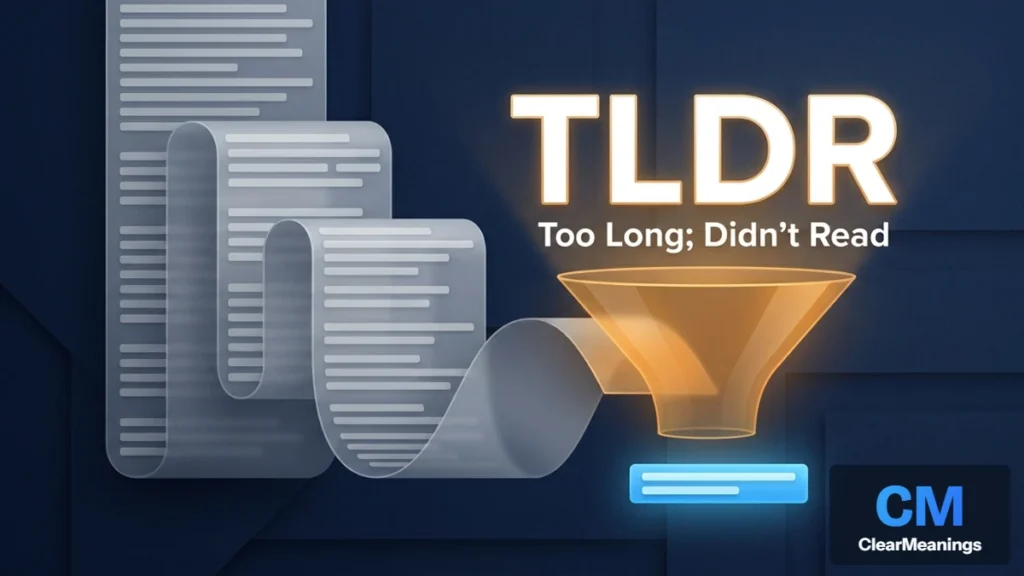

TLDR stands for "too long; didn't read." People use it in two ways: as a label for a short summary of a long post, or as a reaction meaning "that was too much text for me."
This guide covers both uses, the tone behind each, and whether TLDR belongs in your work messages. More terms like it are in the slang category hub.
TLDR Meaning: "Too Long; Didn't Read" Explained in Plain English
TLDR (also written TL;DR or tl;dr) is an abbreviation for "too long; didn't read." It either introduces a short summary of a longer text or tells the writer that their message was too lengthy to read in full.
The same four letters carry two different jobs:
- Summary label: "TLDR: the meeting moved to Friday."
- Reaction: "TLDR" sent in reply to a long paragraph.
The semicolon in TL;DR is a leftover from early internet writing, and most people now drop it.
Why People Type TLDR on Reddit, TikTok, and in Group Chats
TLDR grew out of forum culture, where long posts were common and readers wanted a quick verdict. Writers began adding a one-line recap so skimmers could decide whether to keep reading.
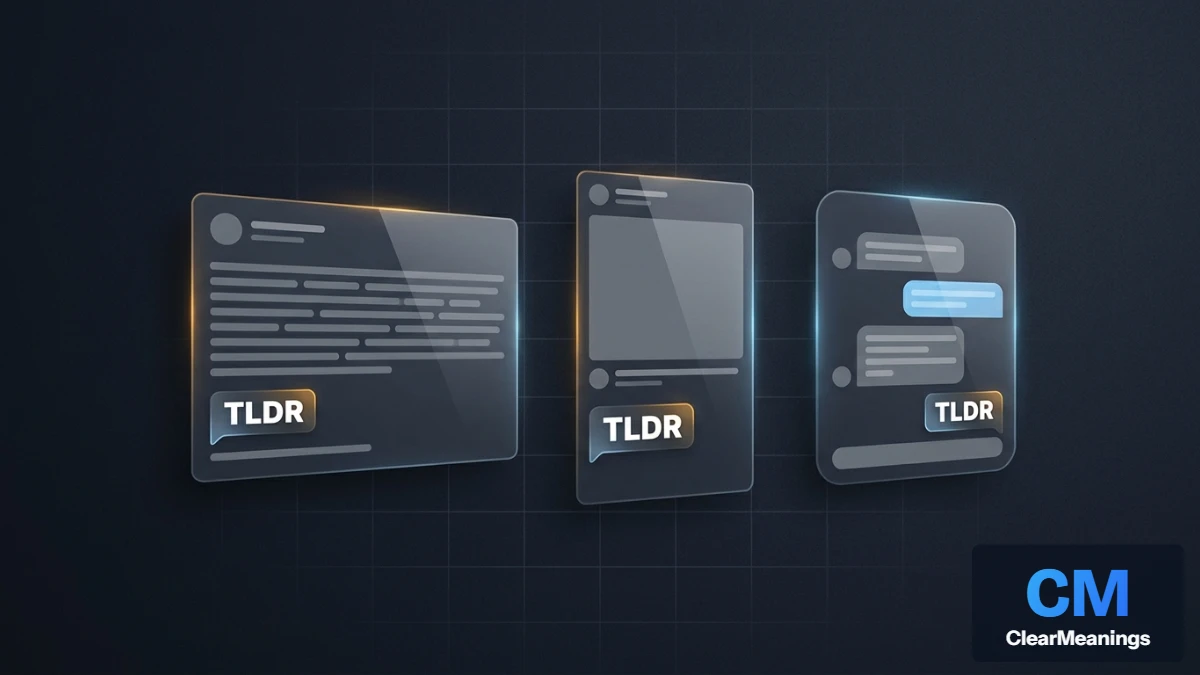
Today the term shows up in a few places:
- Reddit: Long posts often end or open with a "TLDR" line.
- TikTok and YouTube comments: Viewers ask for the "TLDR" of a video or a drama.
- Group chats: Friends send "tldr?" when a message turns into an essay.
The Vibe: Helpful Summary or Rude Brush-Off?
The tone depends on who is typing it and where. A writer who adds their own TLDR is being considerate.
A reader who replies "tldr" to someone else's message is usually being dismissive, even when they mean it as a joke.
| Situation | Who says it | Usual tone |
|---|---|---|
| Summary at the top of a post | The author | Helpful |
| "Can I get a tldr?" | A reader asking nicely | Neutral to friendly |
| "tldr" sent alone in reply | A reader reacting | Blunt, sometimes rude |
| "tldr lol" among close friends | A friend | Playful teasing |
Context decides everything. Between close friends it reads as teasing, but sent to a stranger or a coworker it can sound like you refused to read their effort.
Real TLDR Texting and Social Media Scenarios
Here is how TLDR appears in practice.
A Reddit post summary:
TLDR: Landlord kept my deposit, I sent a formal letter, and I got it back in two weeks.
A friendly request in a group chat:
Maya: ok so the whole situation started on Monday when…
Jordan: can someone give me the tldr?
A blunt reaction:
Chris: (sends four paragraphs about the road trip plan)
Sam: tldr
A comment under a video:
Anyone got the tldr? I don't have 20 minutes.
Each version uses the same term, but only the first two are polite.
Is TLDR Safe for Work? Slack, Email, and Meeting Notes
Verdict: Using TLDR to label your own summary is generally fine in casual workplace channels like Slack. Using it to dismiss a colleague's message is not.

- Slack and Teams: A "TLDR:" line at the top of a long update is common and welcome in most tech and startup cultures.
- Internal email: Acceptable between peers, but a clearer label like "Summary" is safer.
- Client or executive emails: Skip it. The slang can read as informal or careless.
- Replying "tldr" to a coworker: Avoid it. It can sound like you are ignoring their work.
Professional Alternatives to TLDR in Emails and Reports
When the audience is formal, swap TLDR for a label that does the same job:
- Summary
- Key Takeaway
- Bottom Line
- At a Glance
- Action Needed (when the summary is a request)
Place the label at the top, then give one or two sentences. For example: "Summary: The vendor contract renews on March 1, and we need approval by February 15."
How to Reply When Someone Says TLDR to Your Message
Your best reply depends on the tone you picked up.
- Friendly request: Send a one-line recap. "TLDR: plans changed, we're meeting at 7."
- Playful tease: Match the energy. "Fair, that was a lot. Short version: dinner at 7."
- Blunt dismissal: Stay calm and shorten your message. "Key point: I need your answer by Friday."
- At work: Reply with a summary and offer the full detail on request.
If you tend to write long messages, put the main point first so no one has to ask.
TLDR Takeaway: When to Use It and When to Skip It
Use TLDR to summarize your own long writing, or to ask politely for a summary among friends. Skip it as a reply to someone else's message, especially at work or with people you do not know well.
When the setting is formal, choose "Summary" or "Key Takeaway" instead.
Common Questions About TLDR Meaning
What does TLDR stand for in text messages?
TLDR stands for "too long; didn't read." In texts it either introduces a short recap or tells the sender their message was too long.
Is TLDR rude to say to someone?
It can be. Sent alone in reply to someone's message, it often reads as dismissive. Asking "can I get a tldr?" is much softer.
Where does the TLDR on a post go, at the top or the bottom?
Both are common. Many writers put it at the top so readers see the answer first, while others add it at the end as a recap.
Can I use TLDR in a work email?
It is fine in casual internal messages, but formal emails are better served by "Summary" or "Key Takeaway." Avoid it with clients and senior leadership.
What is the difference between TLDR and TLDW?
TLDR means "too long; didn't read," while TLDW means "too long; didn't watch." TLDW is used for videos, podcasts, and streams.